Posts Tagged ‘arrow keys’

Speed up Linux shell use keyboard command alias shortcuts to effiently work like a hacker

Friday, May 1st, 2026

speed-up-linux-shell-use-via-keyboard-command-alias-shortcusts-to-work-like-a-hacker-and-be-efficient

If you want to get truly fast in the Linux Bash shell, stop thinking in commands alone and start doing trivial command tasks by thinking it in keystrokes !
The biggest productivity gains don’t come only by learning new tools, they come from navigating and reusing what is embedded as default functionality, like editing commands , searching through them and shortcuts to run and reuse instantly without need to type again and again.

At the center of this approach is one habit, to try to never type the same command twice.

1. The Allmighty, Reverse Search ( Ctrl + R )

If you learn only one shortcut for a begginning say hello to the King of all bash shortcut commands CTRL + R.

Press:

 
Ctrl + R

Then start typing part of a previous command. Bash will search your history in real time and show the most recent match.

Example:

(reverse-i-search)`ssh': ssh user@server

Press:
To cycle further one command match back:

Ctrl + R


again 

Edit before running use:

(right arrow)

To run found cmd simply press  Enter.

This is dramatically faster than scrolling through history or retyping long commands. Over time, your shell history becomes a searchable command database.

2. Stop annoying re-typing: navigate the Line instantly

When editing a command, don’t hold arrow keys—jump instead:

Go to the beginning of line

Ctrl + A

Move to the end of command string:

Ctrl + E

Jump back one word

Alt + B

Jump forward one word ahead

Alt + F

These shortcuts let you fix mistakes or modify long commands in seconds.

3. Precise Delete strings

Precise deletion is just as important as movement:

Delete everything before cursor position:

Ctrl + U  

Delete everything after cursor position:

Ctrl + K

Delete previous word from cmd string:

Ctrl + W

Delete next word in command string

Alt + D  

Instead of holding backspace, you surgically remove chunks of text.

4. Reuse arguments without rewriting

Bash has built-in shortcuts for reusing parts of previous commands:

Repeat last command, type in shell

!!

Last argument of previous command

!$

Add all arguments from previous command to a command

!*


For example on use last argument from previous command:

mkdir project
cd !$

This jumps into the directory you just created without retyping its name.
 

hipo@jeremiah:/usr/local/bin$ find . /usr/local/bin/ /bin/ /usr/bin -iname 'ls'

/bin/ls

/usr/bin/ls

hipo@jeremiah:/usr/local/bin$ echo !*

echo . /usr/local/bin/ /bin/ /usr/bin -iname 'ls'


To only get the file name of

5. Fix Mistakes Instantly hack

Made a typo? You don’t need to retype the whole command.

Use the shortcut:

^old^new

Example:

hipo@jeremiah: ~$ ls -al /bin/sl
ls: cannot access '/bin/sl': No such file or directory
hipo@jeremiah: ~$ ^sl^ls
ls -al /bin/ls
-rwxr-xr-x 1 root root 151344 Sep 20  2022 /bin/ls

Bash reruns the previous command with the correction applied.

6. Use history without running history cmd

The quick access to last and previous commands, is perhaps known by most but for novice people starting will shell it is worthy mention:

Scroll through commands:

Keyboard Arrow Up / Down keys ↑ / ↓

run command number n from history !n :

To re-run cmd from history line 10

$  !10

To lets say you want to get last 10 commands from history:

$ history 10

Instead of getting full comand history with

$ history

Use the Ctrl + R which is faster shortcut to arrow keys and walking through history.

7. Use Auto-Complete

The good old well known Tab key is well known one by almost all sysadmins, but I’ll mention it anyways.

Auto-complete file / command
Single Tab press

Show all matches
Press Tab twice

This reduces typing and prevents errors – especially with long file paths.

8. Edit the previous command straight in editor

For complex commands, use:

Ctrl + X, Ctrl + E

This opens your last command in your default editor. You can comfortably edit multi-line or complicated commands, then save and execute.

9. Clear and Reset Quickly

Clear the screen (same as clear ):

Ctrl + L

Cancel current command:

Ctrl + C

Exit shell:

Ctrl + D  

These keep your terminal clean and under control.

10. Background and Foreground Control

You can manage running processes with the keyboard too:

Pause (suspend) active running process on cmd line:

Ctrl + Z

Resume process in background:

$ bg

Bring back to foreground:

$ fg  

This is especially useful when you accidentally start something in the foreground.

11. Memorize shortcuts / improve shell habits

When these shortcuts become automatic, habit for you will soon reap the benefits.

You will then no longer need to, constantly retype long command lines, you will not loose time to point with the mouse, you save time on editing your command line:

Of course getting it as habit will take few hours to a day.

Start with just building two habits:

  1. Use Ctrl + R instead of retyping

  2. Use Ctrl + A / Ctrl + E instead of arrow keys

Once those stick, layer in the others.


12. Start using fzf fuzzy finder command utility


To get even better command line search and easier manage things with command line binds use fzf.
 

# apt install –yes fzf

$ source /usr/share/doc/fzf/examples/key-bindings.bash


The fzf command-line tool enhances Linux terminal productivity by replacing the standard, rigid  Ctrl+R  history search with interactive, real-time fuzzy matching.
It offers a visual interface for searching command history, file paths via  Ctrl+T , and directories using  Alt+C  [Source]. Installing fzf enables a highly efficient workflow, allowing users to find and execute commands faster.

 For a complete use cases check GitHub fzf page.

Final Thought

Efficient command line use in Bash is not only about doing less typing, it is about doing more work with less effort, so you can have more time for the important stuff.
The keyboard shortcuts are already there for long time and computer hackers (i mean old school system programmers) has been using them for ages not only in bash but in ksh, zsh, csh and  waiting to remove friction from everything you do.
Master them, and the shell stops being a place where you type in like a secretary, but a enjoyable more fun place to spend time on.


Improve default picture viewing on Slackware Linux with XFCE as Desktop environment

Saturday, March 17th, 2012

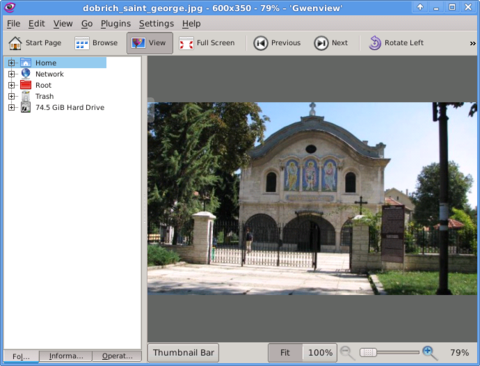
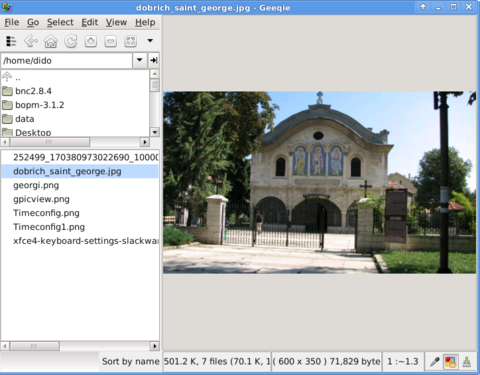
Default XFce picture viewer on Slackware Linux is GIMP (GNU Image Manipulation Program). Though GIMP is great for picture editting, it is rather strange why Patrick Volkerding compiled XFCE to use GIMP as a default picture viewer? The downsides of GIMP being default picture viewing program for Slackware's XFCE are the same like Xubuntu's XFCE risterroro, you can't switch easily pictures back and forward with some keyboard keys (left, right arrow keys, backspace or space etc.). Besides that another disadvantage of using GIMP are;
a) picture opening time in GIMP loading is significantly higher if compared to a simple picture viewer program like Gnome's default, eye of the gnomeeog.

b) GIMP is more CPU intensive and puts high load on each picture opening

A default Slackware install comes with two good picture viewing programs substitute for GIMP:
 

  • Gwenview

    Gwenview on Slackware Linux picture screenshot XFCE

  •  
  • Geeqie
  • Geeqie Slackware Linux Screenshot XFCE

    Both of the programs support picture changing, so if you open a picture you can switch to the other ones in the same directory as the first opened one.
    I personally liked more Gwenview because it has more intutive picture switching controls. With it you can switch with keyboard keys space and backspace

    To change GIMP's default PNG, JPEG opening I had with mouse right button over a pic and in properties change, Open With: program.
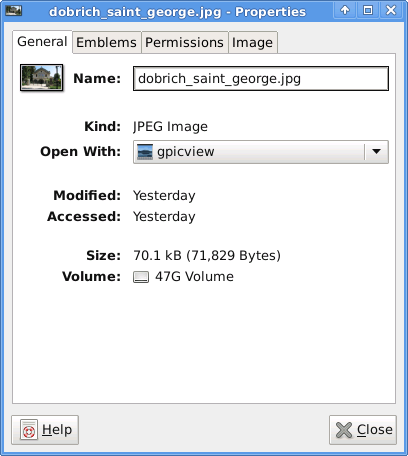
    XFCE4 Slackware Linux picture file properties window

    If you're curious about the picture on on all screenshots, this is Church – Saint George (situated in the city center of Dobrich, Bulgaria).
    St. Georgi / St. George Church is built in 1842 and is the oldest Orthodox Church in Dobrich.
    In the Crimean War (1853-1856) the church was burned down and was restored to its present form in 1864.

    gpicview is another cool picture viewing program, I like. Unfortunately on Slackware, there is no prebuild package and the only option is either to convert it with alien from deb package or to download source and compile as usual with ./configure && make && make install .
    Downloading and compiling from source went just fine on Slackware Linux 13.37gpicview has more modern looking interface, than gwenview and geeqie. and is great for people who want to be in pace with desktop fashion 🙂
Alex the Alligator – a nice retro style Nintendo / GameBoy like Free Software game for GNU / Linux

Tuesday, December 20th, 2011

Alex the Alligator Free Software 4 colors game Intro GNU Linux screen

Alex the Alligator is a Free Software (Open Sourced) arcade game licensed under the General Public License (GPL)
The game is quite of fun and especially the music totally kicks ass! 😉

The game plot is simple but fun in the good Spirit of oldschool Super Mario like arcade games.
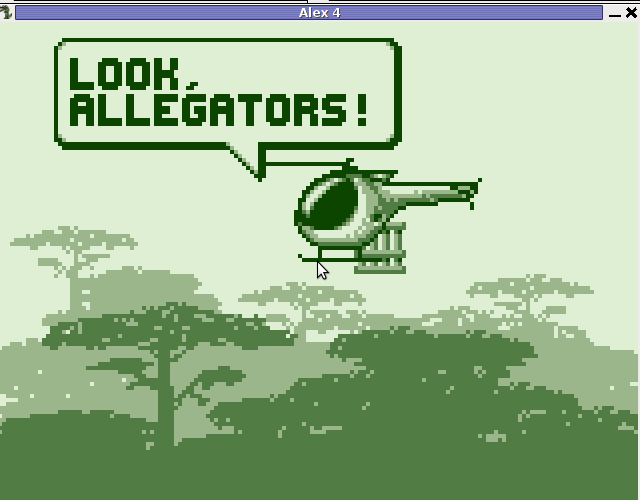
Alex the Alligator evil human kidnapper poachers helicopter, GNU / Linux

In the game you are a little cute crocodile whose (crocodile) girlfriend is kidnapped with a helicopter by the evil human poachers.
As you love her too much and you're determined to grow a crocodile family with this croco-girl you start a long quest to save her from possible zoo slavery or killing for a crocodile skin boots.
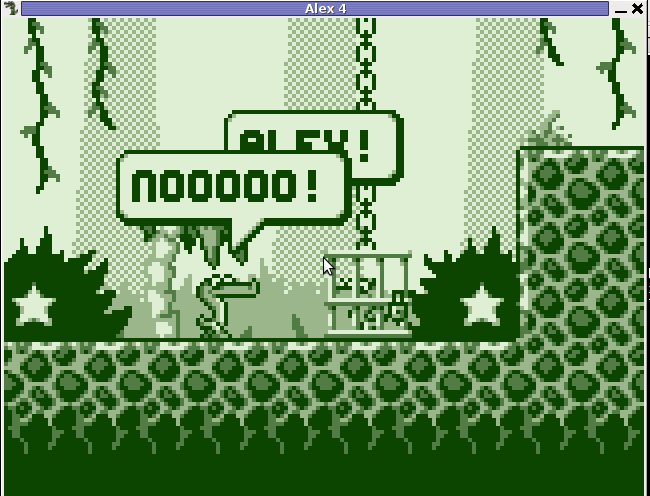
Kidnapping Lola dropping a cage Linux screenshot

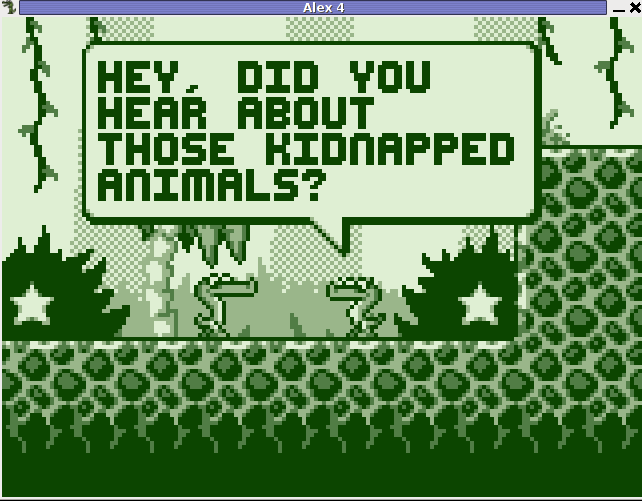
The quest for kidnapped girlfriend (LOLA) liberation wents through the harsh jungles.
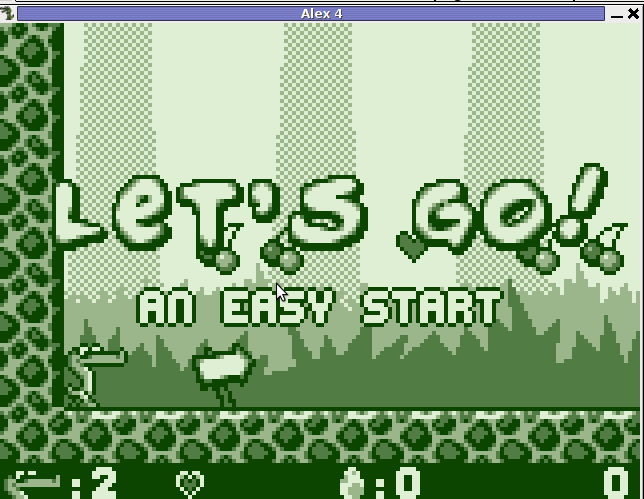
Alex The ALligator level 1 on Linux screenshot

Alex The Alligator has a version for both Windows and Linux ports. The Linux port is available for most major distributions including Debian, Ubuntu, Fedora etc.

To install the game on Debian and Ubuntu with apt-get issue:

debian:~# apt-get --yes install alex4
...

After installing the game can be run from command line using cmd:

alex4

The game controls are as follows;
 

  • Arrow Keys – Movement
  • Alt – Jump
  • Ctrl – Fire (if you have previously collected Eggs

Alex the Alligator is also equipped with a MAP editor, so if you really want to contribute the game development, take some time create some maps and submit to game's official website http://allegator.sourceforge.net/ . On the game website there are few other variations of the Alex the Alligator as well as extra game maps.
Explanation on which keys can be used to create maps is found in the game manual, e.g.:

debian:~$ man alex4

If you have downloaded some extra game maps from the game sourceforge website, to load them you can use:

Shift+L

Will Alex succeed in saving his girlfriend ? It's up to you 😉

How to fix wrongly configured timezone in Debian GNU/Linux and Ubuntu

Wednesday, August 3rd, 2011

During the install of a new Debian GNU/Linux server I was in a real hurry, so I mistakenly choose a wrong timezone of US/Pacific

As a consequence the server date and time was incorrect and I had to fix that to adjust to the proper server location which of this case was:Europe/London

Here is the quick fix:

debian:~# dpkg-reconfigure tzdata

Next I choose my timezone from the ncurses interface navigating with arrow keys and used ntpdate to synchronize the time for the server like so:

debian:~# ntpdate time.nist.gov
3 Aug 16:02:26 ntpdate[26658]: adjust time server 192.43.244.18 offset 0.000802 sec

Done 😉